AI Readiness Audit Handoff: What to Check
Use this handoff checklist to inspect an AI audit: traceable findings, complete costs, operating boundaries, and a next step another builder can price.
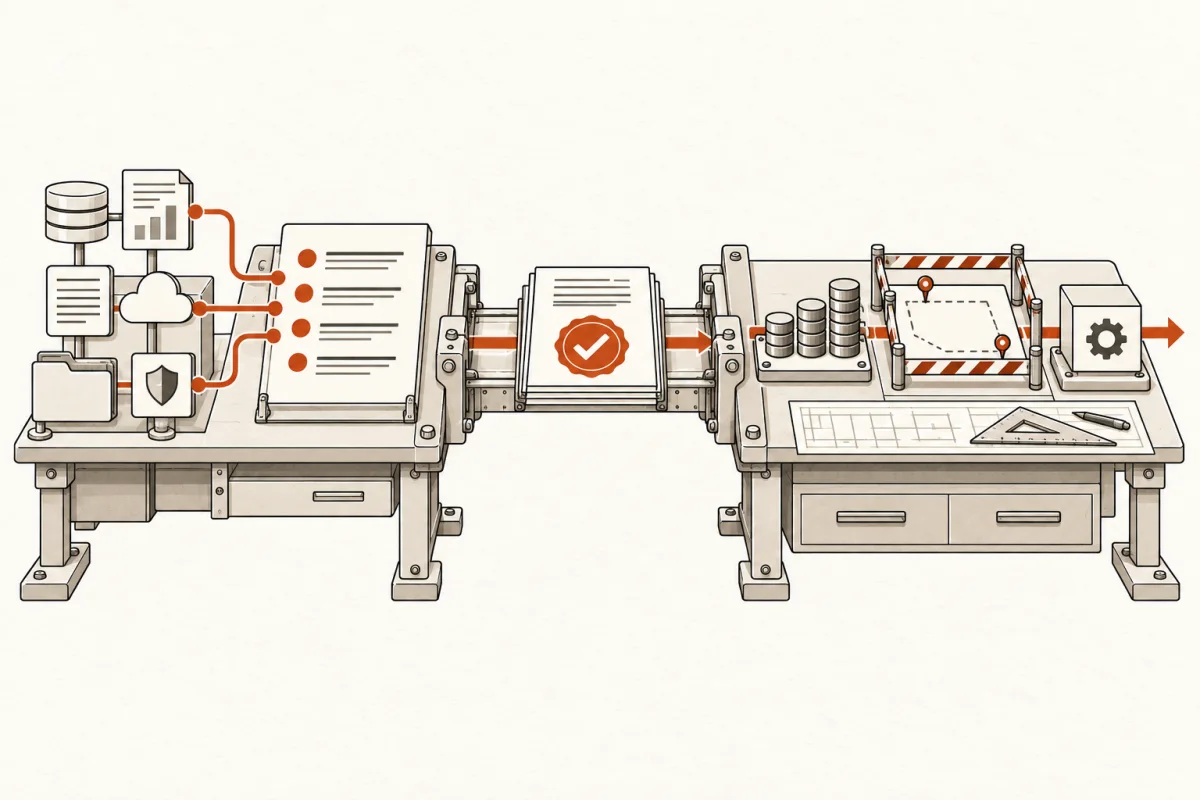
The useful test of an AI readiness audit comes at handoff: can you use its findings to make a build decision? A polished presentation is not enough if a builder still has to rediscover the workflow, guess at the costs, or invent acceptance criteria.
Use this checklist when reviewing an audit deliverable. For the definition, price, and scope of our service, read what an AI readiness audit includes. For an illustrative document, inspect the sample audit; it illustrates the deliverable and does not report client results.
Can you trace an opportunity to its source?
Each recommended workflow should identify the source of the finding: a process walkthrough, an example record, a system export, or an observation that still needs verification. Separate what was measured from what was supplied in an interview or assumed for planning.
Ask to see the path from the incoming work to its completed outcome. Who receives it? Where is it recorded? Which person approves it? Where does it wait? If the recommendation says only "automate customer service," the scope is still too broad to price reliably.
Does the economic case include the work that remains?
A useful estimate counts review time, exceptions, maintenance, model usage, and connected software. Returned staff capacity is not automatically a payroll reduction. If the case relies on redeploying that capacity, name the work it will support and how you will check whether that happened.
Use the ROI model to inspect assumptions. Ask for the conditions that would make the project unattractive, not just the scenario that supports a purchase.
Are the operating boundaries written down?
The handoff should describe the source of truth, permitted data routes, access responsibilities, actions the system may prepare, and actions that require approval. It should also explain how incomplete inputs and conflicting records reach a person.
For a knowledge workflow, that includes who may see each source and how updates reach the system. For an accounting workflow, it includes which records can be read, staged, or posted, and by whom. A general instruction to "keep a human in the loop" does not answer those questions.
Could another builder quote the next step?
Look for a bounded deliverable, dependencies, acceptance criteria, and explicit exclusions. A future builder should be able to identify what is included, what requires further discovery, and which decisions belong to your team.
An audit can recommend a simpler process, an existing software feature, or waiting. It should not require an implementation purchase to become useful. A workflow that is already defined can also go directly to sprint scoping; a paid audit is not a mandatory entrance fee.
Close the handoff with named next steps
For each open question, record the owner, evidence needed, and decision it affects. For each proposed build, record who will approve scope and who will operate the system. Keep the document usable even if you choose another provider.
Compare these checks with the AI Readiness Audit deliverables, or describe one task in the free workflow plan to establish a starting point.
Where this shows upWhat we actually build →